
Called to provide compassionate, equitable care
Called to provide compassionate, equitable care
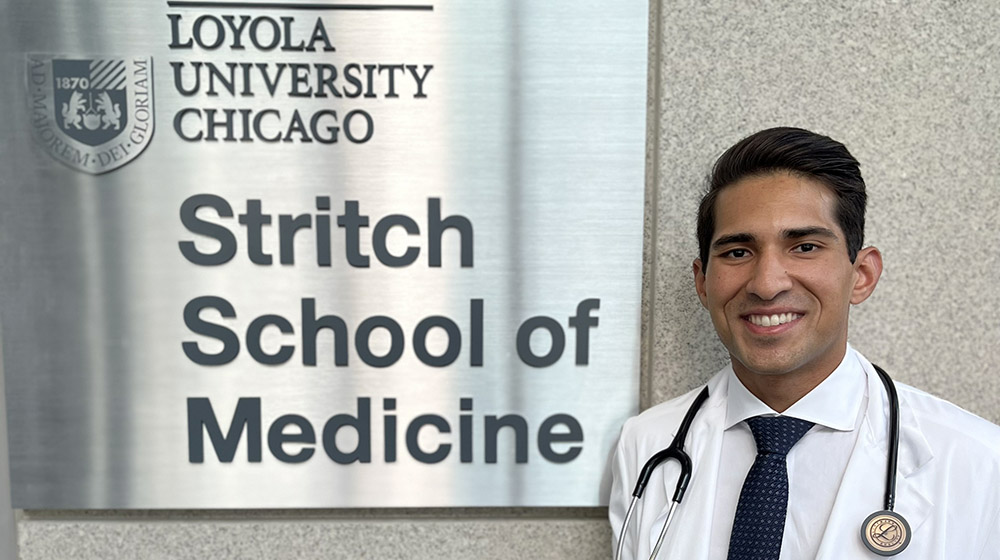
How the concept of “cura personalis” shaped future ophthalmologist Nathan Dhablania’s path from a young age
Cura personalis—the core Jesuit value of caring for the whole person—proved its significance for MD/MPH candidate Nathan Dhablania early on. At just two years old, Dhablania injured the tip of his finger in an accident, and physicians recommended amputation to avoid infection. Knowing this would forever impact his quality of life, his parents soughtanother opinion. Fortunately, they found Amy Ladd, MD, an orthopaedic surgeon at Stanford, who embodied cura personalis.
Rather than rushing to amputation, Dr. Ladd understood that healing was not only about preserving a finger but also about preserving his future—his ability to write, play music, and experience the world without limitation. The compassion she showed his family throughout the healing process demonstrated that medicine is not solely about curing disease but also about restoring wholeness, dignity, and hope. This formative experience now guides Dhablania as he prepares for a career in ophthalmology, dedicated to restoring sight and preventing avoidable blindness.
Turning tragedy into purpose
In 2014, Dhablania, his uncle, and his father hiked eight miles to Vaishno Devi, a Hindu temple high in the mountains of Kashmir. After reaching the temple, Dhablania made two wishes: to enter medical school and to become a physician.
Then in 2015, Dhablania’s uncle started to progressively lose his vision due to undiagnosed diabetic retinopathy. Later that year, his uncle was overtaken by a wave while swimming in Jordan. Without his vision, he was unable to return toshore. This tragedy became a call to action and drove Dhablania’s determination to build a medical career focused onrestoring sight and protecting others from preventable tragedy.
As an undergraduate student studying Health Promotion and Disease Prevention at USC, Dhablania pursued research opportunities at the Southern California Eye Institute. There, he contributed to the African American Eye Disease Study (AFEDS), the largest epidemiologic study of eye disease risk factors in African Americans—a research project that had a profound impact on his future path.
He said, “Seeing firsthand how vision loss intersects with health equity, access to care, and quality of life solidified my decision to pursue a specialty that enables me to combine clinical excellence, public health advocacy, and research tobest serve patients.”
Forging a path rooted in social justice and health equity
Raised in Silicon Valley, Dhablania is a Japanese-speaking Indian Korean American whose multicultural upbringing broadened his understanding of global and community needs. Growing up amidst technological innovation and deep inequality, he directly witnessed how poverty and systemic barriers influence health. To address these disparities, Dhablania volunteered in Title I schools and organized health fairs in Los Angeles, connecting families to nutritioneducation and tangible community resources. Experiences like these further shaped Dhablania’s understanding that healthcare extends beyond hospital walls.
Dhablania was drawn to the Stritch School of Medicine, a place where the mission aligned with his goal of makinghealthcare equitable and accessible for all patients. Coincidentally on his interview day, he met Terry R. Light, MD,FAOA, Professor of Orthopaedic Surgery at Stritch, whose Zoom background featured a photo of Dr. Amy Ladd, the physician whose care had profoundly impacted Dhablania as a toddler.
He said, “I felt an instant connection to Stritch, particularly because of its emphasis on cura personalis and having faculty members who are committed to social justice and advocating for underserved communities.”
Believing that care begins long before patients enter a clinic, Dhablania pursued the dual MD/MPH program at Loyola. His training in epidemiology and health policy during his MPH year in Loyola’s Parkinson School of Health Sciences and Public Health, along with his practicum at the Greater Chicago Food Depository and work supporting community clinicgrants, strengthened his understanding of how to address health inequities at their roots in order to care for all patients, both individually and at the community level.
Dhablania also participated in the Student Training in Approaches to Research (STAR) program under the mentorship of Jhansi Raju, MD, associate professor of ophthalmology at Stritch, and Anuradha Khanna, MD, professor and vice chair for education at Stritch and director of Ophthalmology clinic at Edward Hines, Jr. VA Hospital. With the guidance of his mentors, Dhablania analyzed adherence to hydroxychloroquine (HCQ)-induced retinopathy screening guidelines at Edward Hines, Jr. VA Hospital. The project held deep personal meaning for Dhablania, as his grandmother had battledlupus for many years and ultimately passed away from complications of her disease. She too had been on HCQ, making the study’s focus on screening and prevention especially significant to him.
“The STAR program has been pivotal in shaping my growth as both a clinician-in-training and a researcher by providing tools, mentorship, and protected time for scholarly development,” said Dhablania. “It has provided me with foundational research skills in study design, biostatistics, and manuscript preparation. I also learned to navigate IRB processes and collaborate across disciplines.”
He has presented his work at national conferences and St. Albert’s Day, an annual celebration of research at Loyola, and contributed to manuscripts for JAMA Ophthalmology and the American Journal of Ophthalmology. These experiences deepened his understanding of how research informs both patient care and public health policy. Now part of the Research Honors Program at Stritch, Dhablania continues to investigate cataract surgery disparities among African American and Latino populations, bringing together clinical inquiry and population-level insights.
Looking ahead, Dhablania seeks to establish a community clinic that broadens access to eye care for patients who often go without it, while also engaging in global health initiatives. He envisions a career that integrates clinical practice, research, and service, guided by the same principle that shaped him as a child: caring for the whole person.
By Emma Graves
December 16, 2025
How the concept of “cura personalis” shaped future ophthalmologist Nathan Dhablania’s path from a young age
Cura personalis—the core Jesuit value of caring for the whole person—proved its significance for MD/MPH candidate Nathan Dhablania early on. At just two years old, Dhablania injured the tip of his finger in an accident, and physicians recommended amputation to avoid infection. Knowing this would forever impact his quality of life, his parents soughtanother opinion. Fortunately, they found Amy Ladd, MD, an orthopaedic surgeon at Stanford, who embodied cura personalis.
Rather than rushing to amputation, Dr. Ladd understood that healing was not only about preserving a finger but also about preserving his future—his ability to write, play music, and experience the world without limitation. The compassion she showed his family throughout the healing process demonstrated that medicine is not solely about curing disease but also about restoring wholeness, dignity, and hope. This formative experience now guides Dhablania as he prepares for a career in ophthalmology, dedicated to restoring sight and preventing avoidable blindness.
Turning tragedy into purpose
In 2014, Dhablania, his uncle, and his father hiked eight miles to Vaishno Devi, a Hindu temple high in the mountains of Kashmir. After reaching the temple, Dhablania made two wishes: to enter medical school and to become a physician.
Then in 2015, Dhablania’s uncle started to progressively lose his vision due to undiagnosed diabetic retinopathy. Later that year, his uncle was overtaken by a wave while swimming in Jordan. Without his vision, he was unable to return toshore. This tragedy became a call to action and drove Dhablania’s determination to build a medical career focused onrestoring sight and protecting others from preventable tragedy.
As an undergraduate student studying Health Promotion and Disease Prevention at USC, Dhablania pursued research opportunities at the Southern California Eye Institute. There, he contributed to the African American Eye Disease Study (AFEDS), the largest epidemiologic study of eye disease risk factors in African Americans—a research project that had a profound impact on his future path.
He said, “Seeing firsthand how vision loss intersects with health equity, access to care, and quality of life solidified my decision to pursue a specialty that enables me to combine clinical excellence, public health advocacy, and research tobest serve patients.”
Forging a path rooted in social justice and health equity
Raised in Silicon Valley, Dhablania is a Japanese-speaking Indian Korean American whose multicultural upbringing broadened his understanding of global and community needs. Growing up amidst technological innovation and deep inequality, he directly witnessed how poverty and systemic barriers influence health. To address these disparities, Dhablania volunteered in Title I schools and organized health fairs in Los Angeles, connecting families to nutritioneducation and tangible community resources. Experiences like these further shaped Dhablania’s understanding that healthcare extends beyond hospital walls.
Dhablania was drawn to the Stritch School of Medicine, a place where the mission aligned with his goal of makinghealthcare equitable and accessible for all patients. Coincidentally on his interview day, he met Terry R. Light, MD,FAOA, Professor of Orthopaedic Surgery at Stritch, whose Zoom background featured a photo of Dr. Amy Ladd, the physician whose care had profoundly impacted Dhablania as a toddler.
He said, “I felt an instant connection to Stritch, particularly because of its emphasis on cura personalis and having faculty members who are committed to social justice and advocating for underserved communities.”
Believing that care begins long before patients enter a clinic, Dhablania pursued the dual MD/MPH program at Loyola. His training in epidemiology and health policy during his MPH year in Loyola’s Parkinson School of Health Sciences and Public Health, along with his practicum at the Greater Chicago Food Depository and work supporting community clinicgrants, strengthened his understanding of how to address health inequities at their roots in order to care for all patients, both individually and at the community level.
Dhablania also participated in the Student Training in Approaches to Research (STAR) program under the mentorship of Jhansi Raju, MD, associate professor of ophthalmology at Stritch, and Anuradha Khanna, MD, professor and vice chair for education at Stritch and director of Ophthalmology clinic at Edward Hines, Jr. VA Hospital. With the guidance of his mentors, Dhablania analyzed adherence to hydroxychloroquine (HCQ)-induced retinopathy screening guidelines at Edward Hines, Jr. VA Hospital. The project held deep personal meaning for Dhablania, as his grandmother had battledlupus for many years and ultimately passed away from complications of her disease. She too had been on HCQ, making the study’s focus on screening and prevention especially significant to him.
“The STAR program has been pivotal in shaping my growth as both a clinician-in-training and a researcher by providing tools, mentorship, and protected time for scholarly development,” said Dhablania. “It has provided me with foundational research skills in study design, biostatistics, and manuscript preparation. I also learned to navigate IRB processes and collaborate across disciplines.”
He has presented his work at national conferences and St. Albert’s Day, an annual celebration of research at Loyola, and contributed to manuscripts for JAMA Ophthalmology and the American Journal of Ophthalmology. These experiences deepened his understanding of how research informs both patient care and public health policy. Now part of the Research Honors Program at Stritch, Dhablania continues to investigate cataract surgery disparities among African American and Latino populations, bringing together clinical inquiry and population-level insights.
Looking ahead, Dhablania seeks to establish a community clinic that broadens access to eye care for patients who often go without it, while also engaging in global health initiatives. He envisions a career that integrates clinical practice, research, and service, guided by the same principle that shaped him as a child: caring for the whole person.
By Emma Graves
December 16, 2025